EU Project Pravo-Justice Presented a Commentary to Book Five of the CUBP on Individual Insolvency
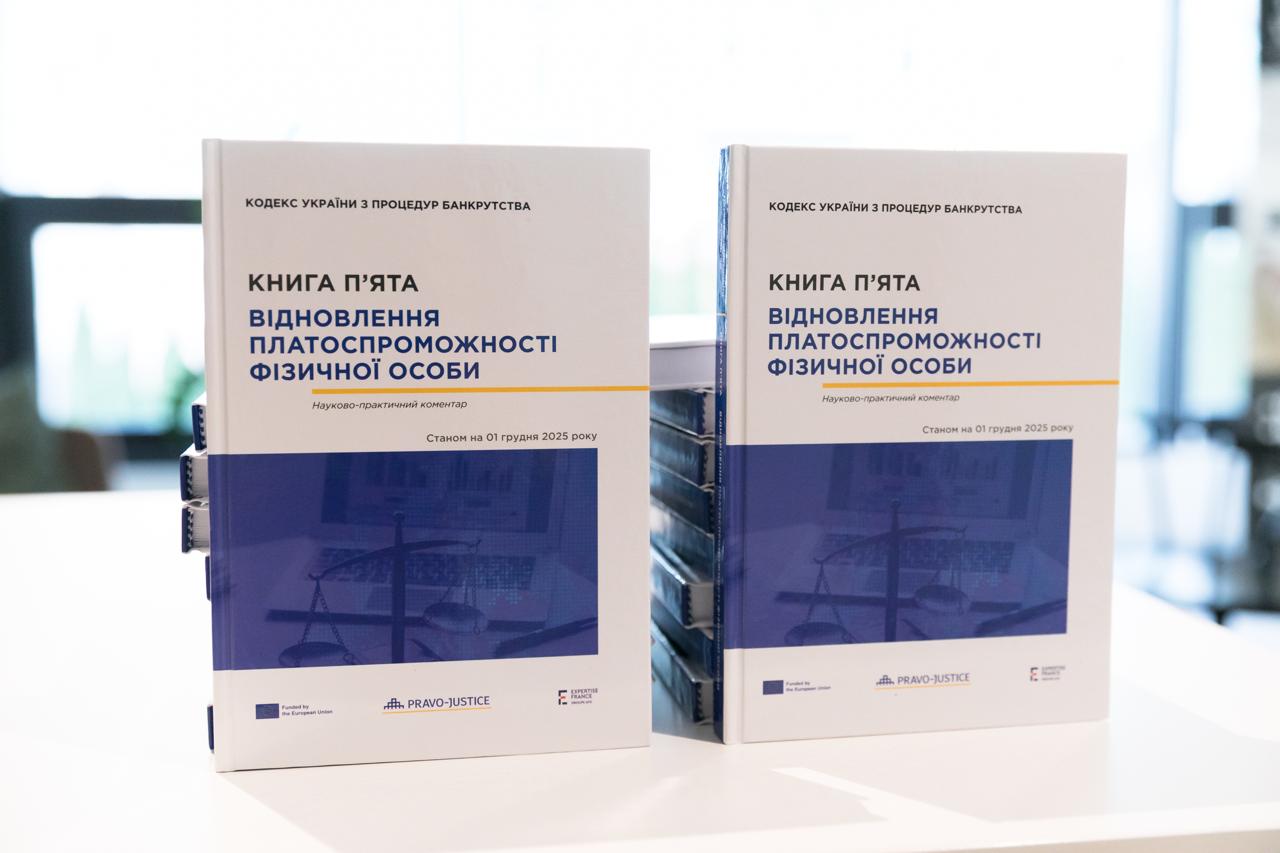
On 3 April, a roundtable discussion “Bankruptcy of Individuals: Current Issues of Theory and Court Practice” was held. The event was organised by EU Project Pravo-Justice in cooperation with the Yurii Fedkovych National University of Chernivtsi. The event was attended by representatives of the Ministry of Justice of Ukraine, judges, in particular justices of the Economic Court of Cassation of the Supreme Court, insolvency officers, academics, and experts of EU Project Pravo-Justice.
The purpose of the roundtable was to present the Scientific and Practical Commentary to Book Five of the Code of Ukraine on Bankruptcy Procedures and discuss the specifics of the application of the respective procedure.
Serhii Donkov, Director of the Bankruptcy Department of the Ministry of Justice of Ukraine, emphasised that the presented Commentary is of utmost importance for the development of individual insolvency and the formation of a unified law enforcement practice.
“The insolvency of individuals, introduced together with the Bankruptcy Code of Ukraine, caused a lot of debate at the time, but practice has proven its effectiveness. Today, there is a dynamic growth in the number of proceedings, which demonstrates how much it is demanded and important for citizens,” said Serhii Donkov.
He also added that bankruptcy combines elements of various branches of law - civil, administrative and sometimes criminal, which leads to a special need for high-quality practical materials, such as the presented Commentary.

Iryna Zharonkina, Enforcement and Protection of Property Rights Component Lead at EU Project Pravo-Justice, said that the Commentary is a continuation of the large-scale analytical work of the Project experts, which began in 2023 and was updated to reflect the development of practice in 2025.
“Although the bankruptcy procedure for individuals was introduced before the martial law, its formation took place in the context of the full-scale invasion of the Russian Federation. This has led to the emergence of new complex issues, in particular regarding the status of debtors, access to property, and implementation of procedures. The commentary is based not only on theoretical approaches, but primarily on a comprehensive analysis of a large array of decisions of economic courts of all instances. Therefore, it can be a useful tool for judges, insolvency officers, practicing lawyers and academics,” said Irina Zharonkina.

In her turn, Iryna Butyrska, author of the Commentary, stated that the institute of individual insolvency is an opportunity for a bona fide debtor to start their financial life from scratch. And the quality of law enforcement in this area depends primarily on how deeply one understands the way the law works in practice.
“The purpose of the Commentary is not only to explain the content of each article of Book 5 of the CUBP, but also to demonstrate how specific provisions have been interpreted by the courts in practice, which conclusions have become permanent and which are still under discussion, and what mistakes are most often made by participants in proceedings. The commentary is designed as a practical tool that allows a specialist not only to get acquainted with the rule, but also to get a clear understanding of its application, risks and effective strategies of behaviour,” said Iryna Butyrska.
Andrii Butyrskyi, co-author of the Commentary, justice of the Economic Court of Chernivtsi Region, said that the document covers in detail the issues that are most often the subject of litigation, including signs of insolvency, good faith of the debtor, balance of interests of the parties, criteria for approving a restructuring plan, grounds for debt relief and assessment of debtor’s behaviour.
“The Commentary systematises the positions that have already gained stability and provides examples of different law enforcement approaches that existed at different stages of individual insolvency of. This allows us not only to understand the logic of the courts, but also to see the general trends in the development of the practice,” said Andrii Butyrskyi.
Oleh Vaskovskyi, Secretary of the Bankruptcy Chamber of the Economic Cassation Court of the Supreme Court, expressed the opinion that the presented Scientific and Practical Commentary to Book Five of the CUBP is an important step in systematising and understanding the new area of insolvency of individuals, which has already emerged as an independent and dynamic law enforcement institute.
“Such developments allow for a deeper understanding of the balance between the social nature of individual bankruptcy and the economic logic of the procedures, and ensure a more consistent application of the law – primarily at the stages of commencement of proceedings and restructuring, where the efficiency of the entire procedure is forged,” said Oleh Vaskovskyi.
During the roundtable, not only the participants got acquainted with the Scientific and Practical Commentary to Book Five of the CUBP, but also joined a professional discussion on current issues in the field of insolvency of individuals. The discussion covered the issues of abuse of procedural rights in the relevant proceedings, ways to improve individual insolvency procedures, as well as general approaches to the consideration of such cases.
The speakers paid special attention to behavioural insolvency, when a financial crisis is a consequence of the debtor’s behavioural pattern, as well as to preventive procedures aimed at minimising insolvency risks at an early stage. A significant part of the discussion also touched upon practical challenges in the insolvency proceedings of individuals.
“It is important that the event included not only the presentation of the Commentary, but also a meaningful professional discussion on key issues of insolvency of individuals, which is no less valuable for the development of practice and science,” summed up Vitaliy Hordieiev, Dean of the Law Department of Yurii Fedkovych National University of Chernivtsi.