Simplified Bankruptcy for Small Businesses: Government Draft Law No. 15004 Discussed
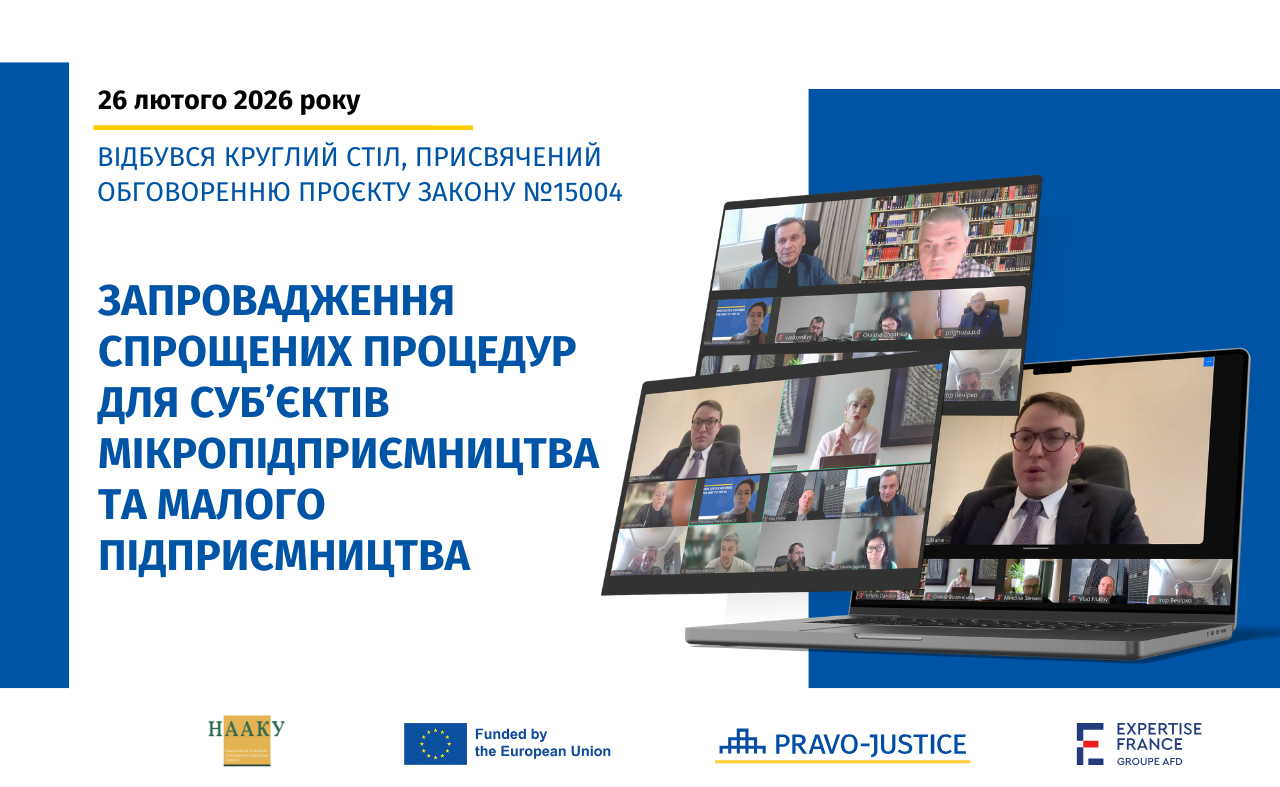
On 26 February, the Ukrainian National Insolvency Trustees Association, together with EU Project Pravo-Justice, held an online roundtable discussion entitled ‘Introduction of Simplified Insolvency Procedures for Micro and Small Enterprises’. The event was dedicated to discussing Government Draft Law No. 15004, which aims to improve bankruptcy procedures for micro and small enterprises and to create more favourable conditions for businesses to regain solvency. Judges, including Supreme Court justices, MPs, bankruptcy trustees, representatives of the bank community, lawyers, scholars, and experts from EU Project Pravo-Justice participated in the discussion.
Iryna Zharonkina, Enforcement and Protection of Property Rights Component Lead at EU Project Pravo-Justice, noted that introducing simplified bankruptcy procedures is part of Ukraine’s European integration commitments and a requirement for receiving macro-financial assistance from the EU.
“The Ukraine Facility Plan sets out several conditions to be met by simplified bankruptcy procedures for micro, small and medium-sized enterprises (MSMEs). In particular, they must be in line with the principles of EU Directive 2019/1023 on a preventive restructuring framework, apply to MSMEs, including private entrepreneurs, ensure access to bankruptcy tools and professional services for MSMEs, and prevent abuse of bankruptcy procedures,” said Iryna Zharonkina.
According to the expert, the Project has already prepared a review of best practices in the area of simplified bankruptcy procedures in EU Member States, a concept for amending the Bankruptcy Code of Ukraine, and conducted an analysis of registered draft laws, taking into account the provisions of the Directive and the UNCITRAL Recommendations on the Insolvency of Micro and Small Enterprises. The experience of EU countries shows that it is important for Ukraine to take into account the practices of other countries; however, it needs to develop its own approach to regulating simplified procedures for micro and small businesses, taking into account economic context and entrepreneurs’ needs.
Oleksii Movchan, a Member of the Ukrainian Parliament and Deputy Chair of the Parliamentary Committee on Economic Development, emphasised that supporting small businesses should be one of the legislative priorities for the country’s economic policy.
“To achieve sustainable economic development, it is essential to create favourable conditions for the development of small and medium-sized enterprises, as they form the foundation of the country’s economic stability. Government policy must prioritise support for this sector. Over time, some of these enterprises grow into large businesses, and even small and medium-sized companies make a significant contribution to the labour market, tax revenues and GDP,” noted Oleksii Movchan.
Artem Danilov, Chair of the UNITA Committee on Research and Methodological Development and Professional Expertise, outlined the position of the professional community of bankruptcy trustees on Draft Law No. 15004. In particular, a number of issues were identified which, in the community’s view, require further refinement, namely: how to verify whether the debtor has assets and analyse contracts, and how to ensure a balance between creditors’ interests and debtors’ liabilities when there is no mandatory involvement of bankruptcy trustees.
Oleh Vaskovskyi, justice of the Commercial Court of Cassation within the Supreme Court noted that a key factor ensuring the efficiency of bankruptcy proceedings for this category of businesses is to clearly identify the entities to be covered by such proceedings.
“The law must specify clear eligibility criteria – that is, what entities can make use of such mechanisms. Moreover, an artificial reduction in the length of procedures will not yield a positive outcome. Issues relating to assets, debtor liability and interaction with creditors require time and a balanced approach. That is exactly why amendments to the legislation should be drafted following a detailed analysis and taking into account the experience of countries where simplified bankruptcy is already operating effectively,” said Oleh Vaskovskyi.
Representatives of the banking sector and financial institutions also shared their comments and suggestions on the draft law during the discussion. Vladyslav Filatov, former director of the Bankruptcy Department at the Ministry of Justice of Ukraine, noted that developments in the insolvency sector have a direct impact on the country’s economic dynamics.
“Ukraine is paying a very high price for its misguided approach to the development of the insolvency system. After all, insolvency acts as a kind of remedy for the economy: without it, the economy is, at the very least, stagnating. Unfortunately, this area is still underestimated in Ukraine. I hope that through joint efforts we will be able to change the situation and ensure further development, particularly with regard to micro and small businesses,” said Vladyslav Filatov.
Overall, the attendees of the roundtable discussion concluded that legislative regulation of simplified bankruptcy procedures for micro and small businesses should combine efficiency with guarantees of security and transparency, ensure a balance between the interests of creditors and debtors, and ensure proper control over assets.
“Only such an approach will create favourable conditions for the development of small businesses and align Ukrainian legislation with European standards. For its part, the Ukrainian National Insolvency Trustees Association stands ready to contribute to the improvement of legislation in order to streamline frameworks governing insolvency proceedings,” said Oleksandr Bondarchuk, Chair of the UNITA.