Training for Judges on Working with Electronic Evidence was Held with the Support of EU Project Pravo-Justice
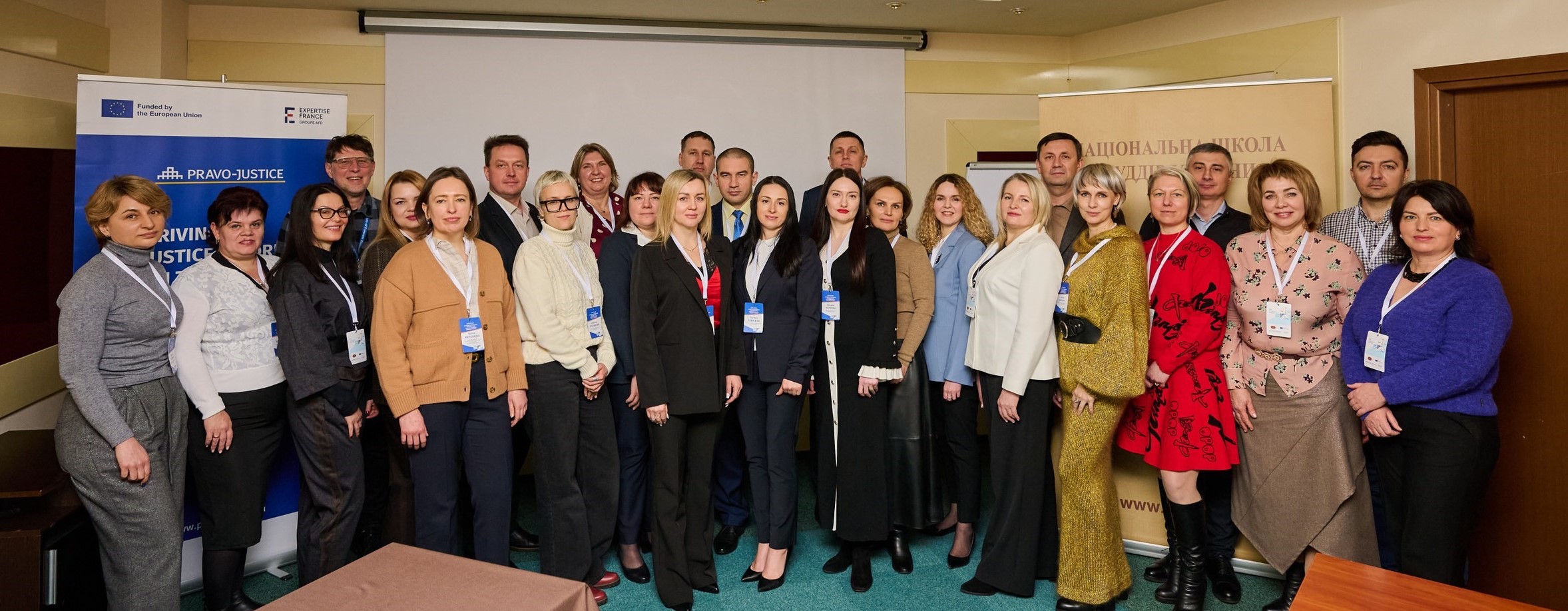
On 19-20 February, the National School of Judges of Ukraine jointly with EU Pravo-Justice Project conducted a two-day training for judges on the topic “Specifics and Special Legal Status of Electronic Evidence. Challenges of Our Time”. The event was attended by about 40 judges from different jurisdictions, including newly appointed judges of appellate courts. The trainers were judges, forensic experts, attorneys, and experts from EU Project Pravo-Justice.
“We initiated this training because the development of digital technologies and the emergence of artificial intelligence pose new challenges to justice. Judges are working increasingly often with electronic evidence, and this requires new knowledge and skills. That is why the main goal of the event was to enhance judges’ professional competence in working with such evidence,” said Liubov Honchar, Head of ToT Department at the National School of Judges of Ukraine.

In turn, Iryna Zharonkina, Enforcement and Protection of Property Rights Component Lead at EU Project Pravo-Justice, stressed that technological development was significantly changing the nature of evidence. Today, a significant part of legally relevant information exists exclusively in electronic form – emails, social media data, metadata, etc.
“Judges are increasingly faced with the issues of admissibility, authenticity and evaluation of such evidence. That is why such trainings are of exceptional practical importance: they help to understand real cases; learn how to work effectively with digital evidence and make more informed decisions,” said Iryna Zharonkina.

Pawel Rybicki, International Expert at EU Project Pravo-Justice, spoke about the European perspective of the development of electronic evidence and outlined the key conditions for its effective use in criminal proceedings.
“Electronic evidence is no longer an exception, but a new reality of justice. Trust in electronic evidence can no longer rely on individual solutions. It requires systemic approaches involving law, standards, infrastructure, organisation and training. Effective processing of digital evidence requires coordinated action from different actors: judges, experts, and legislators”, said Pawel Rybicki.
The expert also stressed that it is extremely important for Ukraine to take into account international experience, adapt the regulatory framework and strengthen cooperation between all participants in the justice process in the context of rapid digitalisation.
In general, during the training, the participants discussed a wide range of issues related to the use of electronic evidence in court proceedings. In particular, they considered in detail the general provisions and legal nature of electronic evidence; its place in the system of evidence; and the specifics of legal regulation. Considerable attention was paid to the practical aspects of its examination in court proceedings – from collection and recording to reliability assessment. A separate block was devoted to digital evidence in forensic activities, in particular, the specifics of appointing examinations of video and audio recordings, digital images, PCs, and electronic communications. The training participants also looked into the current practice of the Supreme Court regarding electronic evidence, which shapes the standards of its admissibility and relevance in Ukrainian courts.
They also focused on the issues of securing electronic evidence and the new challenges associated with the development of AI technologies. They discussed how modern technology affects the process of collecting, analysing, and assessing evidence, and how important it is to maintain a balance between the efficiency of justice and the protection of the right to privacy.