The Correctional Programme for Developing Assertive Communication in Penitentiary Institutions Successfully Piloted
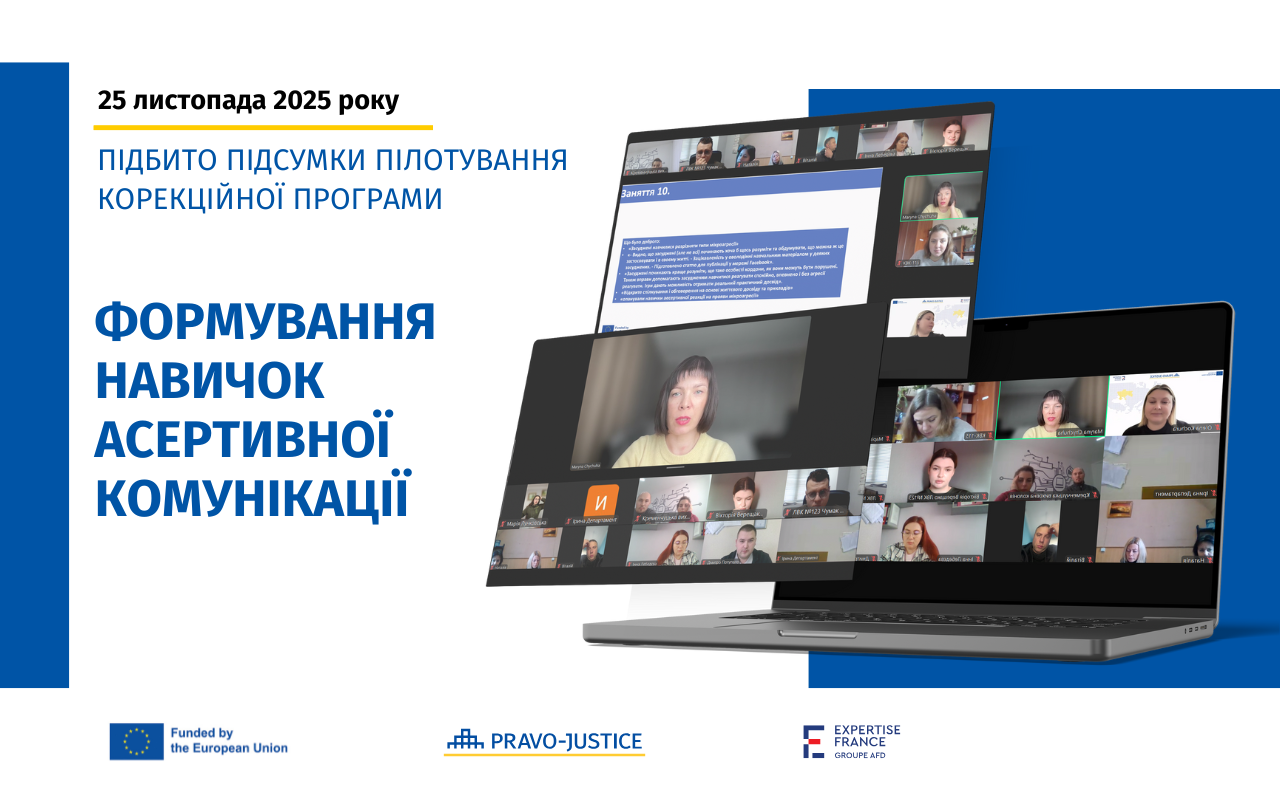
A correctional programme entitled ‘Developing Assertive Communication Skills’, developed by Maryna Chychuha, expert at EU Project Pravo-Justice, has been successfully piloted in seven Ukrainian correctional facilities. The implementation of the programme was coordinated by Olena Kochura, Key Expert on Reforming the Penitentiary System and Probation at EU Project Pravo-Justice.
Over the course of five months, the programme was implemented in the Manevychi (No. 42), Synelnykove (No. 94), Odesa (No. 14), Lityn (No. 123), Kaharlyk (No. 115), and Konotop (No. 130) correctional colonies, as well as in the Kremenchuk juvenile correctional colony. In total, 56 convicted persons took part in the programme.
“The creation of the correctional programme ‘Developing Assertive Communication Skills’ is not merely another stage of reform, but a genuine step toward a European model of resocialisation – one grounded in evidence-based approaches and respect for human dignity. The programme was developed in line with international standards and is based on cognitive-behavioural therapy; the pilot phase has already demonstrated its effectiveness. Both trainers and participants noted that the sessions promote positive behavioural change, foster constructive communication, and help build healthy relationships with family members, loved ones, friends, and prospective employers after release. We will take into account all suggestions from the psychologists involved in the pilot when updating the programme before submitting it to the Ministry of Justice for approval,” said Olena Kochura, Key Expert on Reforming the Penitentiary System and Probation at EU Project Pravo-Justice.
The psychologists who conducted the sessions noted significant positive changes in convicts’ behaviour and communication after completing the correctional programme, including:
- reduced aggression in communication;
- improved interaction within the group;
- increased awareness of their own emotions and needs;
- an ability to set personal boundaries and to assert them constructively.
“We saw that the positive effect extended beyond the group itself – some participants discussed the topics covered in the sessions with other convicts, using their workbooks and the knowledge they had gained during the programme. This demonstrates both the viability of the correctional programme and its real practical impact,” said Nazar Lunkovskyi, a representative of Manevychi Correctional Colony No. 42.
The psychologists noted that working on emotional literacy and assertiveness was a valuable experience for them as well, helping them to take a fresh look at their own communication style and gain practical tools for work and personal development.
“We have received extremely positive feedback and are convinced that this programme is truly effective, both for convicts and for the staff working with them. The skills of confident and constructive communication have proven their practical value. At the next meeting of the working group, we will review the piloting experience in detail, and by the end of the year, we plan to submit the programme for approval by the Ministry of Justice in order to scale it up to all facilities,” said Dmytro Potupalo, senior inspector at the Division for Social and Educational Work with Convicts in the Department for the Enforcement of Criminal Punishments.